
Arizona Property Tax Values Explained for Real Estate Investors or Why Understanding FCV and LPV Can Help You Make Better Investment Decisions
Every spring, property owners throughout Metro Phoenix receive their Notice of Value from the Maricopa County Assessor. As soon as those notices arrive, we start getting the same questions from investors:
- What is FCV?
- What is LPV?
- Why do two nearly identical homes have completely different property tax bills?
- How can I estimate taxes before I buy an investment property?
These are important questions because property taxes directly affect your cash flow, cap rate, and long-term return on investment. Just as importantly, if you believe your property’s value has been overstated, Arizona gives you only 60 days from the Notice Date to file an appeal. If you don’t understand what you’re looking at, you may miss an opportunity to reduce your tax expense.
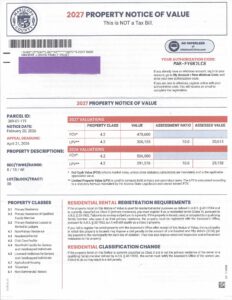
The Three Numbers Every Arizona Investor Should Understand
Arizona calculates property taxes using three values:
- Full Cash Value (FCV)
- Limited Property Value (LPV)
- Assessed Value
Understanding how these numbers work together is essential when analyzing rental properties, flips, and long-term investments.
1) Full Cash Value (FCV)
Full Cash Value is the Assessor’s estimate of a property’s market value. The Assessor estimates FCV using one or more accepted appraisal methods:
- Comparable sales (most residential properties)
- Cost Approach (often newer homes)
- Income Approach (commercial and income-producing properties)
Because FCV reflects market value, it can rise or fall significantly from year to year as market conditions change. Think of FCV as the County’s opinion of what the property is worth and not necessarily what your taxes are based on.
2) Limited Property Value (LPV)
This is where Arizona becomes very different from many other states. Unlike states that tax property based directly on market value, Arizona calculates taxes using Limited Property Value (LPV). For investors, LPV is often much more important than FCV because LPV and not market value is generally the number used to calculate property taxes. This is why two homes with identical market values can have dramatically different annual tax bills.

The LPV calculation follows two statutory methods established under Arizona Proposition 117:
- Rule A
- Rule B
Rule A – The 5% Growth Cap
Most investment properties fall under Rule A. The formula is straightforward:
Current LPV = Last Year’s LPV × 1.05 (maximum increase)
However, the new LPV can never exceed the property’s current Full Cash Value. Therefore, the Assessor compares:
- Last Year’s LPV × 1.05
- Current FCV
The lower number becomes the new LPV. This system prevents property taxes from increasing as rapidly as market values during strong appreciation cycles. For buy-and-hold investors, this often creates a valuable tax advantage over time.
Rule B – When Property Values Are Reset
Rule B applies when a property undergoes significant physical or legal changes, including:
- New construction
- Major additions
- Extensive remodeling
- Parcel splits or combinations
- Changes in zoning or land use
- First-time assessment of newly created parcels
Instead of using last year’s LPV, the Assessor establishes an entirely new LPV based on comparable properties. This process is commonly called the LPV Ratio Method. The Assessor determines:
- the property’s current Full Cash Value
- the typical LPV-to-FCV ratio for similar nearby properties
The new LPV is then calculated using that ratio.
Rule B Example
Assume nearby comparable properties show the following:
House A
- FCV: $400,000
- LPV: $320,000
- Ratio: 80%
House B
- FCV: $380,000
- LPV: $300,000
- Ratio: 79%
House C
- FCV: $420,000
- LPV: $336,000
- Ratio: 80%
Average LPV ratio = 80%
Now suppose your newly constructed investment property has an FCV of $500,000.
Its new LPV would likely be:
$500,000 × 80% = $400,000 LPV
Beginning the following year, the annual 5% Rule A limitation resumes.

Why This Matters to Investors
This system often surprises out-of-state investors. Two neighboring homes can each be worth $600,000 but have completely different property tax bills. Why?
One owner may have owned the property for 20 years, allowing LPV to increase only gradually each year. Another property may have recently been rebuilt, subdivided, or reassessed under Rule B, resulting in a much higher LPV. If you’re evaluating rental properties using only the seller’s current tax bill, you could significantly miscalculate future operating expenses.
3) Assessed Value
Once LPV has been established, Arizona applies the residential assessment ratio. For most residential property Assessed Value = 10% of LPV
Example:
LPV = $500,000
Assessed Value = $50,000
4): Apply the Tax Rate
Each taxing jurisdiction has its own property tax rate based on the County, City, School District, Community College District, and other Special Districts like Sewer or Fire Districts. The annual property tax calculation is:
(Assessed Value ÷ 100) × Tax Rate
Example
LPV = $500,000
Assessed Value = $50,000
Mesa Tax Rate = 3.7797
Calculation:
($50,000 ÷ 100) × 3.7797
Estimated Annual Property Tax:
$1,889.85

Where Investors Can Find LPV
Before purchasing an investment property, always verify the property’s LPV. You can find it through the county assessors office web site, or the seller may be able to provide the annual Notice of Value. Reviewing LPV before making an offer can provide a much more accurate estimate of future ownership costs. In Arizona it is important to
Additional Investor Considerations
Don’t Assume Current Taxes Will Continue! Some properties receive exemptions for qualifying seniors, veterans, or individuals with disabilities. If those exemptions disappear after closing, your actual tax bill may be higher than the seller’s current taxes.
Review the Notice of Value Carefully. Property values are updated annually. Even experienced investors should review their Notice of Value each year to determine whether an appeal may be appropriate.
Remember the Appeal Deadline. Arizona generally allows 60 days from the Notice Date to challenge the Assessor’s valuation. Missing that deadline could mean paying more property tax than necessary for another year.
In an upcoming blog, we will get into rental property tax rates versus owner occupied tax rates. For now, just rest assured that Arizona does not have a higher property tax rate simply because a home is rented rather than owner-occupied.
In conclusion, Understanding Arizona’s property tax system gives investors a significant advantage. Knowing the difference between Full Cash Value, Limited Property Value, and Assessed Value allows you to estimate operating expenses more accurately, examine rental properties with greater confidence, understand why neighboring properties have different tax bills, identify potential assessment errors and decide whether filing a valuation appeal makes financial sense.
If you’re evaluating a property anywhere in Maricopa County or Pinal County, we’d be happy to help you review its FCV, LPV, estimated taxes, and overall investment potential before you buy.
Please contact Vince Davis or Evelyn Szymanski, the Agents with Options ™ at 920 664 6349 or at info@agentswithoptions.com. We also have a YouTube channel with more information on this and many other topics, so please check it out at youtube.com/@theagentswithoptionsrealestate